Shiva
The Destroyer
47 m
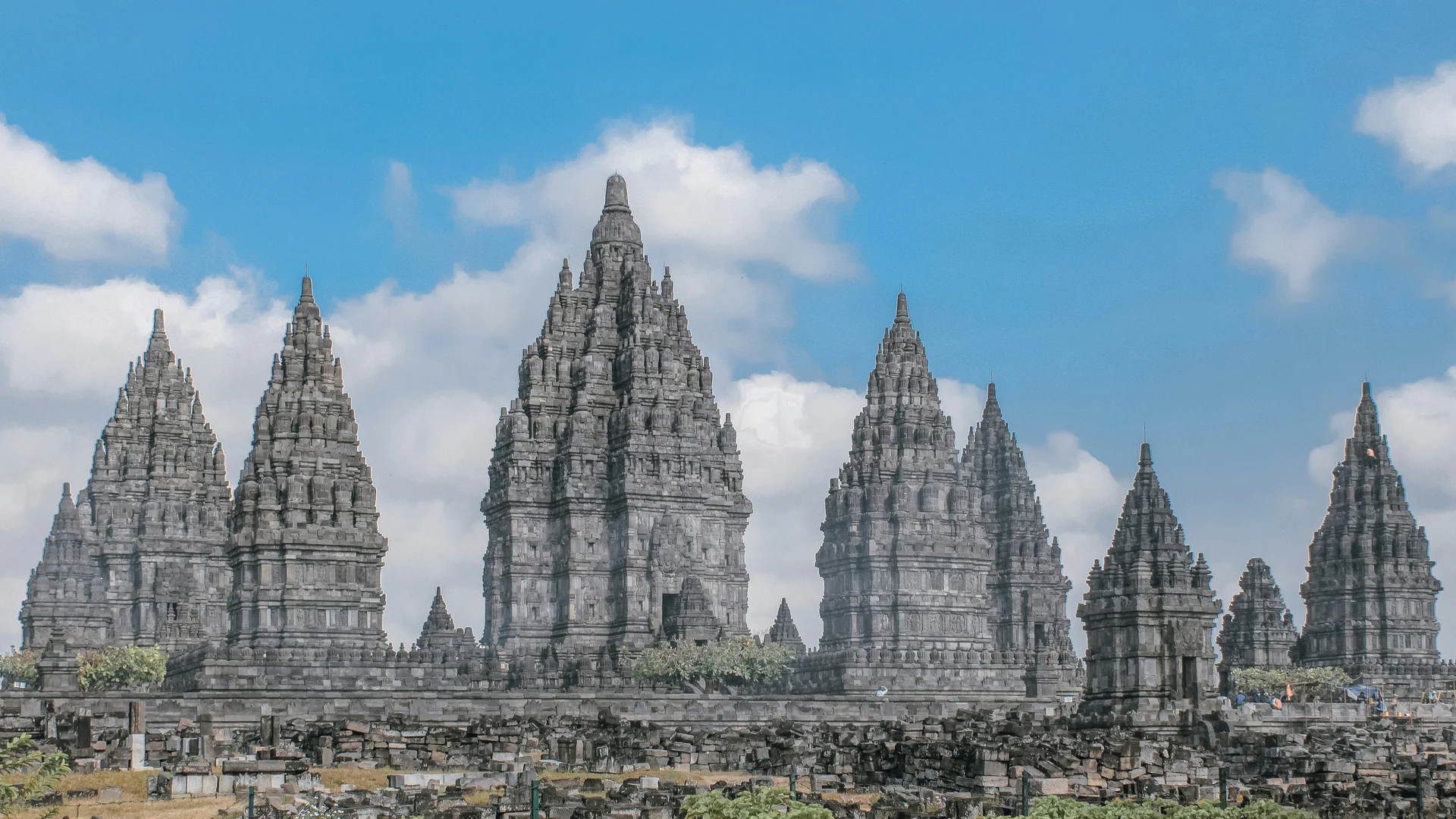
Yogyakarta · Central Java, Indonesia
Three towers rise straight off the Javanese plain — Shiva at forty-seven metres, Brahma and Vishnu flanking him — and each one faces a smaller shrine built for the animal that carries him. Around them lie the broken rows of more than two hundred and forty lesser temples, and along the inner walls the whole Ramayana runs in carved stone.
The late afternoon is the slot worth planning around: ballet nights have their own separate ticket, and the Ramayana is staged in the same grounds.
The shape of the courtyard
Prambanan’s inner courtyard is not six separate buildings. It is three facing pairs — each god opposite the animal that carries him, across a narrow stone yard. Once you see the pairing, the whole compound reads.
The Destroyer
47 m
the bull
The tallest candi and the centre of the row. Its inner chamber holds the four-armed Shiva Mahadeva; three further chambers hold Durga (the "Slender Virgin" of local legend), Ganesha and Agastya.
The Creator
33 m
the goose
Stands to the south of Shiva. Its balustrade carries the closing half of the Ramayana relief, continuing the sequence that begins on the Shiva temple.
The Preserver
33 m
the eagle
Stands to the north. Its reliefs break from the Ramayana entirely and tell the Krishnayana — the story of Krishna — instead.
How to read the walls
The inner balustrades of the Shiva and Brahma temples carry the Ramayana as a continuous relief. It is meant to be read while walking clockwise — pradakshina — keeping the temple on your right, starting at the eastern stair of the Shiva candi. Follow it in that order and the panels run as a narrative; walk it the other way and the story runs backwards. The Vishnu temple carries the Krishnayana instead.
Walk it in this order
The Ramayana relief begins here, on the inner face of the balustrade. Face the wall with the temple on your right.
Walk clockwise. This is pradakshina, the direction of circumambulation — and it is also simply the order the panels were carved in.
The abduction of Sita, the alliance with the monkey army and the search all play out across the panels of the first temple.
The relief does not end where the Shiva balustrade does. It continues on Brahma, to the south, and concludes there.
The northern temple is not part of the Ramayana at all. Its panels tell the Krishnayana, and are best read as their own sequence.
Ceremonial days, full-moon Hindu rituals and state functions can restrict access to specific enclosures at short notice. Check the operator’s channels on the morning of your visit if your date falls near one of these.
Book your entry
Pick your date for the three towers and their courtyard below — GetYourGuide handles the booking, shows what's actually open on that date, and converts the total into your own currency before you pay.
See Prambanan tickets & prices ↗Good to know
Prambanan Temple opens daily at 06:30 WIB (Western Indonesian Time). Closing and last-entry times can vary, and last entry can be earlier than closing, so check on the day you go.
Prambanan is about 17 kilometres east of central Yogyakarta. You can go by taxi, private car, intercity bus or Trans Jogja bus. The entry ticket does not include a transfer; some tours add hotel pick-up.
Dress modestly — shoulders and knees covered. Free sarongs are provided at the entrance if you arrive in shorts or sleeveless tops. The complex is large and exposed to sun, so comfortable walking shoes, a hat and sunscreen are recommended.
Hindu. Prambanan is dedicated to the Trimurti — Shiva, Vishnu and Brahma. It was built in the 9th century by the Hindu Sanjaya dynasty, around the same period that the nearby Buddhist monument of Borobudur was constructed by the Sailendra dynasty.
2–3 hours is ideal for the Lara Jonggrang central group. This gives you time to explore all three main towers, study the Ramayana reliefs, and walk through the surrounding archaeological park without feeling rushed. Add another 1–2 hours if you also want to see the outer Sewu, Bubrah and Lumbung temples.
Yes, many international visitors do this independently. The two UNESCO sites are roughly 90 minutes apart by car, and most travellers in Yogyakarta hire a private driver to cover both in a single day. Combined Borobudur–Prambanan day trips that include transport between the two are also widely available and often work out simpler than arranging a driver yourself.
Choose your option and date, then complete the booking on GetYourGuide, our booking partner. Your confirmation and digital ticket are sent to you by email and can be shown on your phone, with the details you need for your visit.
Cancellation terms are set by GetYourGuide and the operator, and are shown in full on the booking screen before you pay. The Prambanan entry ticket is non-refundable once booked. Tours and other options show their own cancellation terms, so check the option you select.
Yes. You pay on GetYourGuide's checkout, not on this site, and this site never sees your card details.
Your confirmation shows what to present at entry. The digital ticket is redeemed at the kiosk near the entrance.