Tickets, tours and how to choose
Prambanan tickets: entry, tour or combo
Entry ticket, guided tour or Borobudur combo: what each Prambanan option covers, how it differs from the operator's own ticket, and how to choose.
Book your Prambanan entry ↗Quick answer
Book the entry ticket if you will get to Prambanan yourself and are happy to walk the grounds on your own. Book a tour if you want hotel pick-up, a driver, or Borobudur on the same day. The entry ticket is valid on one chosen date, includes no hotel transfer and is non-refundable. Tours and combinations show their own terms before you pay. Prambanan is the Hindu complex of tall towers; Borobudur is the Buddhist monument, and the two make a long but workable day.
Prambanan and Borobudur at a glance
| Prambanan | Borobudur | |
|---|---|---|
| Faith | Hindu | Mahayana Buddhist |
| Shape | Tall towers | Stacked platforms |
| From Yogyakarta | About 17 km east | About 40 km northwest |
| Best known for | Ramayana reliefs | Reliefs, Buddha statues |
| UNESCO listed | 1991 | 1991 |
Three ways to book Prambanan
You can visit Prambanan in three ways. The entry ticket gets you into the grounds on a date you choose and nothing more: you arrange the travel and walk the site yourself. A tour adds a driver and hotel pick-up, and some include a guide, which suits you if you would rather not organise transport. A combination day pairs Prambanan with Borobudur, the other great temple near Yogyakarta, in a single booking. Each option shows its own inclusions and cancellation terms before you pay, so compare those rather than just the names. Prices differ by option and by who is travelling, so we leave them to the booking calendar, where the figure is current.
- Entry ticket: admission only, one chosen date
- Tour: a driver and pick-up, sometimes a guide
- Combination: Prambanan and Borobudur in one day
- Ballet or sunset package: built around the evening show
What the entry ticket includes
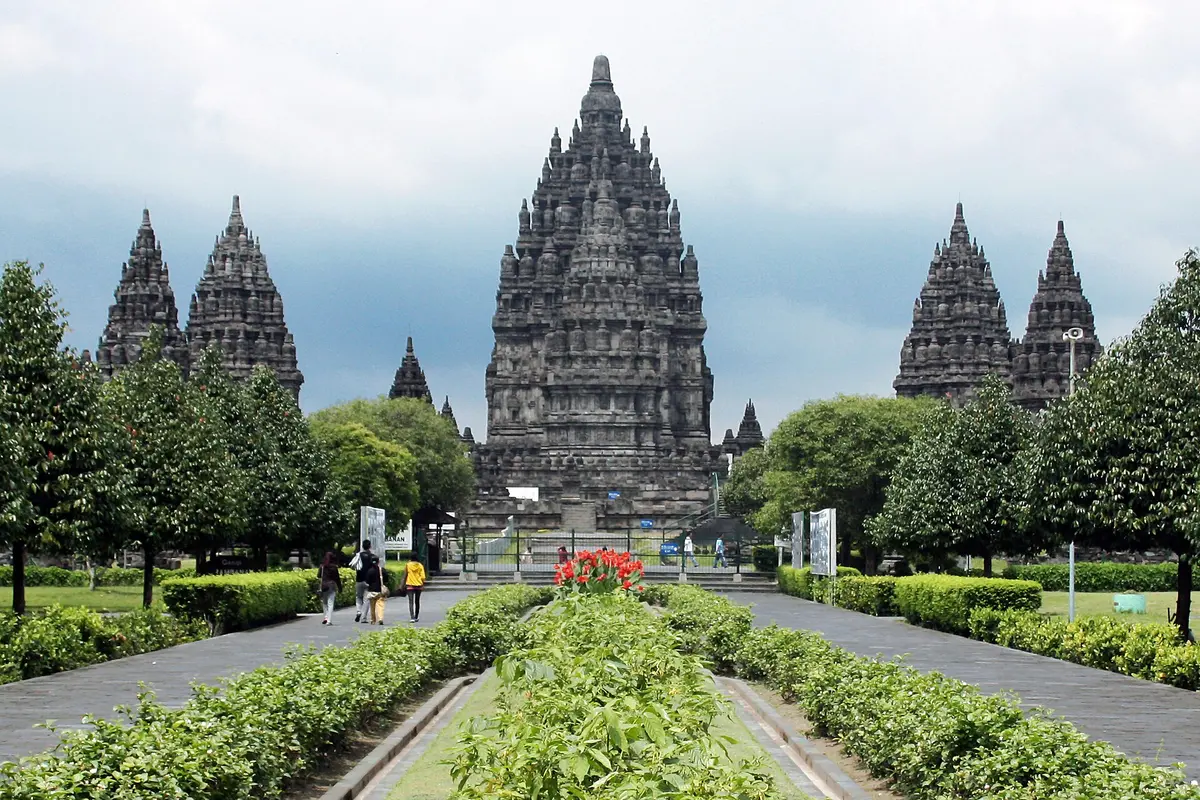
The entry ticket is a digital pass for the day you select. You redeem it at the kiosk near the entrance. Hotel transfers are not included, children aged 0 to 2 are admitted free, and you cannot re-enter once you leave. Host or greeter support is in English and Indonesian. The operator describes its own Prambanan ticket as covering the Prambanan temples, the Lumbung, Bubrah and Sewu temples, and the Prambanan Museum, so there is more here than the three main towers. Read your option's description to see how it matches. The temple is a place of worship as well as a monument, so plan to dress for it; our practical guide covers what to wear and what to carry.
Read next: What to wear at Prambanan: visit guide
Entry ticket or a guided visit?
The entry ticket comes with no guide. If you want one, you have a few routes. Tours that stop at Prambanan bring a driver, and a guide may be included at Borobudur but not at Prambanan, where one can be arranged as an extra. The operator also runs its own guided sunset programme for foreign visitors on selected dates, led by an English-speaking local guide for groups of 15 to 20 people. It is non-refundable and cannot be rescheduled. If you prefer to go alone, our guide to what to see explains the layout. A guided option is worth the extra if the carved reliefs matter to you, because the panels tell a long story that is easier to follow when someone shows you where it begins.
Read next: What to see at Prambanan
Prambanan and Borobudur in one day
Some combination tours start at Prambanan, add the nearby Sewu temple, then drive on to Borobudur. Pick-up from a hotel, the airport or the station in Yogyakarta is part of the tour, and the day can run from about four to about ten hours depending on the option. Read the option names closely: the temple tickets are included only in the option that says so, and shared tours follow the group's pace. A private option gives you more control. The drive between the two sites takes roughly an hour and a half, so add road time at each end of the day.
Prambanan or Borobudur?
Both are ninth-century monuments that UNESCO listed in 1991, and they are not interchangeable. Prambanan is a Hindu complex whose tallest temple, the Shiva temple, reaches 47 metres, with the Ramayana carved along its walls. Borobudur is a Mahayana Buddhist monument of nine stacked platforms, decorated with 2,672 relief panels and originally 504 Buddha statues. Choose by what you want to look at: tall carved towers and a story told in stone, or terraces and stupas. With a day to spare, many visitors do both. If you can only see one, Prambanan is the nearer to Yogyakarta, at about 17 kilometres east of the city, while Borobudur lies about 40 kilometres to the northwest.
Booking here or on the official site
The operator's official ticket site sells Prambanan admission directly, with separate categories for domestic and foreign visitors, and it has an English version. Booking through GetYourGuide, the route this site links to, lets you see prices in your own currency and pick a tour or combination in the same place. The trade-off is terms: the entry ticket here is non-refundable once booked, and tours have their own. If you book on the official site instead, read its terms the same way before you pay. Both routes lead to the same temple; what changes is the currency, the language of the checkout, the range of tours on offer and the cancellation rules, so pick the one whose terms you are comfortable with.
Add the Ramayana Ballet?
The ballet is a separate ticket. The operator's ticket site lists Ramayana Ballet Prambanan as its own product, and the entry ticket covers temple admission only. Wikipedia describes the performance as staged in the Trimurti open-air theatre on the west side of the complex. The schedule and the venue can change, so read the dates on the option you choose rather than assuming a night. Several tours bundle a sunset visit, a ballet ticket and transport, which is the simplest way to line the temple and the show up in one day. If you book the ballet on its own, remember it is a different ticket from temple admission, so check that you hold both.
Dates, Mondays and closure days
Choose your date with the calendar in mind. The entry ticket is valid only on the date you select. On Mondays access is limited for maintenance, and the area around the three main temples can be closed, so a Monday visit may mean the outer grounds only. The operator closes the park for Nyepi, the Balinese day of silence, which falls on a different date each year; in 2026 it was 19 March. Last entry can be earlier than closing time, so do not plan to arrive at the end of the day. Holiday periods bring more visitors, so if your dates fall in one, book the date early and keep it flexible only where your option allows.
What you are paying to see
Prambanan was built in the mid-ninth century and is the largest Hindu temple complex in Indonesia. Wikipedia reports that it once held 240 temples. The Shiva temple stands 47 metres tall, with the Brahma and Vishnu temples beside it at 33 metres, and the inner walls carry the Ramayana in stone relief. Of the 224 smaller temples around them, only six have been rebuilt, so much of the site is rows of fallen stone. The 2006 earthquake damaged the complex, and restoration of the smaller temples continues.
Before you pay: a short checklist
A few minutes of checking prevents most problems. Confirm that your date is not a Monday if you want to approach the main temples. Check whether your option includes transport, a guide and temple tickets, because options on the same page differ. Read the cancellation line, since the entry ticket cannot be refunded. Check the language and the number of travellers. Then keep your confirmation handy: it holds the details you will need at the entrance, and the kiosk near the gate is where the digital ticket is redeemed. Save a copy where you can open it without a signal.
Read next: Getting to Prambanan from Yogyakarta
Who this isn't for
If you want a plan you can change, the non-refundable entry ticket is not for you; a tour with its own cancellation terms may fit better. If you want a guide to explain the temples, the entry ticket gives you none. If you can only visit on a Monday and want to stand beside the main towers, expect limits. And if stairs and uneven paths are a problem, know that the grounds are described as accessible but with some stairs and rough paths. And if you like to decide on the day, note that the entry ticket is tied to the date you select.
Frequently asked questions
Is the Prambanan entry ticket refundable?
No. The entry ticket is non-refundable once booked and valid only on the date you select. Tours and other options show their own cancellation terms before you pay.
Does the entry ticket include a guide or hotel transfer?
No. It covers entrance only. Hotel transfers are not included and there is no guide. Tours add a driver, and some add a guide at one of the temples.
Can I buy Prambanan tickets on the official website?
Yes. The operator's ticket site sells Prambanan admission and has separate categories for domestic and foreign visitors. It is available in English.
Is Prambanan worth visiting if I am seeing Borobudur?
Yes, if you want something different. Prambanan is a Hindu complex of tall towers and carved Ramayana reliefs. Borobudur is a Buddhist monument of stacked platforms and stupas.
Is the Ramayana Ballet included in the ticket?
No. The ballet is sold separately. Some tours bundle it with a sunset visit and transport, so check what your option lists.
Is Prambanan open on Mondays?
Partly. Access is limited on Mondays for maintenance, and the area around the three main temples can be closed. Check the operator's channels before you go.
Sources
- Prambanan Temple ticket (official ticket site)
- All activities and ticket categories (official ticket site)
- Kala Senja Prambanan guided sunset programme (InJourney Destination Management)
- Prambanan Temple closed for Nyepi 2026 (InJourney Destination Management)
- Prambanan (InJourney Destination Management)
- Prambanan (Wikipedia)
- Borobudur (Wikipedia)